Filter content
The Language of Flamenco: How Performers Communicate During a Live Show
At Teatro Flamenco Sevilla, rhythm, listening and the connection between performers creates a unique experience at every live flamenco show.
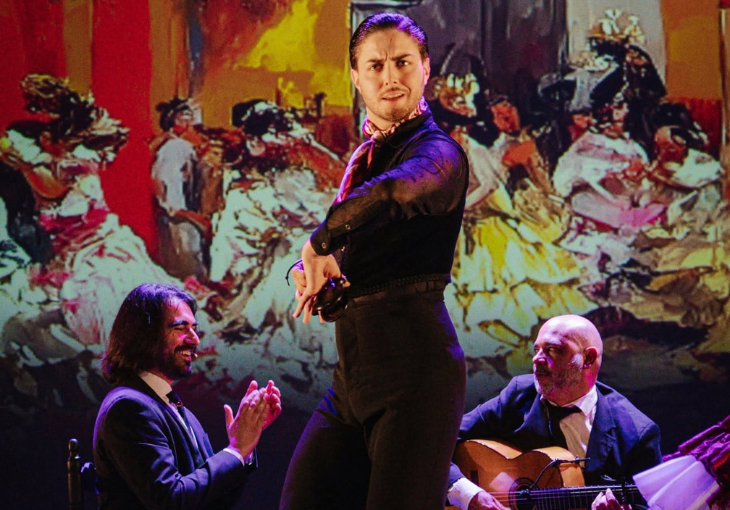
There are moments during a live flamenco show when the performers seem to anticipate one another’s actions. The dancer begins a movement and the guitar responds. The singer extends a phrase and the dancer waits for precisely the right moment to continue. Everything happens naturally, apparently without signals or cues.
This connection is one of the most fascinating aspects of flamenco. Behind it lie years of learning, a deep understanding of the different flamenco styles (palos) and a form of communication that combines rhythm, movement, eye contact and listening.
At Teatro Flamenco Sevilla, this relationship between performers is essential to understanding what happens on our tablao (flamenco stage).
But how do they manage to coordinate with one another and what signals do they use to communicate during a performance?
A Language Learnt Through Listening to Flamenco
Flamenco has its own set of musical codes that allow performers to recognise what is happening and anticipate certain changes.
It is not a written language or a set of instructions that must always be followed in exactly the same way but rather a knowledge acquired through training, practice and continuous interaction with other performers.
The singer needs to recognise the structures of the dance, the guitarist must understand the characteristics of each singing style and the dancer has to identify the musical moments when they can step in.
This ability to listen is particularly important when performers share a stage having never worked together before.
Although each performer has their own artistic personality, their knowledge of flamenco's musical codes allows them to find a common language.
Compás: the rhythmic foundation that unites singing, dancing and guitar playing
Flamenco compás, or rhythmic structure, is one of the fundamental elements of this communication.
Each flamenco style has its own rhythmic characteristics, which influence the way performers sing, play and dance. Bulerías, for example, follow a twelve-beat cycle with a distinctive pattern of accents, while tangos are based on a four-beat structure.
Performers do not need to count constantly to recognise these patterns. With experience, the compás becomes internalised and serves as a shared point of reference.
Handclapping (palmas) helps maintain this rhythmic foundation, allowing performers to stay coordinated even when the guitar or footwork introduces variations.
At certain moments, the rhythm may also be implied without every performer marking it explicitly.
This ability to maintain a shared rhythmic reference makes it possible to introduce silences, changes in intensity and different expressive techniques without losing the musical connection.
Who leads the changes during a flamenco show?
One of the distinctive features of live flamenco is that the lead can shift from one performer to another throughout the same piece.
At certain moments, the singing determines how the music develops. At others, the dancer takes the initiative and introduces a new section through a llamada, a rhythmic cue.
The guitar can also introduce an instrumental passage that leads into a vocal section or prepares the dancer's entrance.
There is no one performer who directs everything that happens on stage throughout the performance.
Coordination depends on an understanding of musical structures and each performer's ability to recognise when it is their turn to contribute.
This constant exchange of roles is one of the reasons why flamenco demands such close attention from everyone involved.
Llamadas and remates in flamenco dance
Within this shared language, llamadas and remates in flamenco dance play a particularly important role.
A llamada is a rhythmic cue through which a dancer communicates a musical intention. It can be used to prepare an entrance, signal a transition or let the other performers know that a new section is approaching.
A remate, meanwhile, is used to bring a rhythmic or musical phrase to a close. It can be performed through footwork (zapateado), body movements or a combination of both.
These elements form part of the structure of many flamenco styles, although their execution varies according to each dancer's style and personality.
When a llamada fits naturally within the compás, the guitarist and singer can recognise it and respond almost immediately.
For the audience, this exchange often appears to be a natural sequence of movements and sounds. For the performers, it is the result of shared musical knowledge.
Silence: an integral part of flamenco communication
Although we tend to associate flamenco with the intensity of the footwork, the power of the singing or the sound of the guitar, silence also serves an expressive purpose.
A pause can prepare the entrance of a new verse (letra), draw attention to a dance movement or build anticipation before a concluding flourish.
During these moments, performers must remain attentive and recognise precisely when to continue.
Silence does not necessarily mean that communication has stopped. In many cases, quite the opposite is true: it demands even greater concentration.
A glance or a subtle gesture can then become the signal that allows the music to resume.
This contrast between sound and silence helps build the intensity of a live flamenco show.
Improvisation: when performers respond to the moment
Improvisation is another element that makes this connection essential.
Although performers may agree on the overall structure of a piece beforehand, flamenco allows them to introduce variations as the performance unfolds.
The singer may extend a tercio (a phrase within a flamenco verse), the guitarist may adapt their accompaniment and the dancer may change the length of a footwork sequence.
These decisions require the other performers to listen and respond.
However, improvisation in flamenco doesn't mean the show is performed with no preparation. Improvisation requires mastery of the compás, knowledge of the structures of the different flamenco styles and an understanding of the techniques commonly used in singing, dancing and guitar playing.
Improvisation is built on precisely this knowledge.
Thanks to this foundation, performers can explore new ideas without losing the coherence of the performance.
Complicity: an essential part of flamenco in Seville
Seville has a long-standing historical connection with flamenco. The passing down of knowledge between generations, family gatherings, flamenco clubs (peñas) and venues dedicated to this art form have all helped preserve and develop its different forms of expression.
Learning to listen to and accompany other performers is an integral part of flamenco itself.
The rapport that develops during a performance does not depend solely on how long the artists have worked together. It also comes from sharing musical codes and understanding the expressive possibilities of each flamenco style.
When this connection comes together, the audience can sense how singing, dancing and guitar playing cease to be separate contributions and become a unified artistic performance.
Experience the connection at Teatro Flamenco Sevilla
Understanding how flamenco performers communicate allows you to appreciate this art form from a different perspective.
The next time you go to a flamenco show in Seville, notice how the guitarist responds to the dancer's movements, how the handclapping maintains the compás or how a glance signals a musical change.
These small details reveal the importance of attentive listening and shared knowledge.
At Teatro Flamenco Sevilla, our popular daily, live flamenco show, Pasión, brings together singing, dancing and guitar playing in a performance where communication between the artists is an essential part of the experience.
We invite you to discover this unique flamenco language and experience the connection that comes to life on our tablao. Explore our programme and book your flamenco tickets to enjoy live flamenco.